
Insurance Churn Prediction: A Retention Risk Score on Every Renewal
CovioIQ gives Canadian insurance brokers a churn-risk score on every open renewal, built from four factors already in your records: premium change at renewal, client tenure, number of active policies and how long since you last logged contact. The reasons sit beside the score, so you can see why a renewal is flagged. Scores are estimates; broker judgment required.
The Problem: Renewals at Risk Look Like Every Other Renewal
A renewal list sorted by expiry date treats a long-standing client with four policies the same as a new client facing a large premium increase. Churn-risk scoring flags the renewals that deserve a closer look, and shows why, while there is still time to talk to the client.
Policies enter the renewal pipeline 90 days before expiry
Premium change, client tenure, active policy count and last logged contact
Score at which a renewal is flagged high risk on a 0–100 scale
How the Client Retention Risk Score Works for Insurance Brokers
1. Rules Score Each Renewal
Every open renewal (upcoming, contacted or quoted) starts at 25 points, then:
- •Premium up 20% or more: +35; up 10–19%: +25; any smaller increase: +15
- •Client for under 1 year: +20
- •Exactly 1 active policy: +20; 3 or more: −15
- •No logged contact ever: +15; over 180 days: +12; over 90: +8; over 30: +4; within 30 days: −5
The result is kept between 5 and 98. No quote entered, or no premium increase, adds nothing.
2. Flag High-Risk Renewals
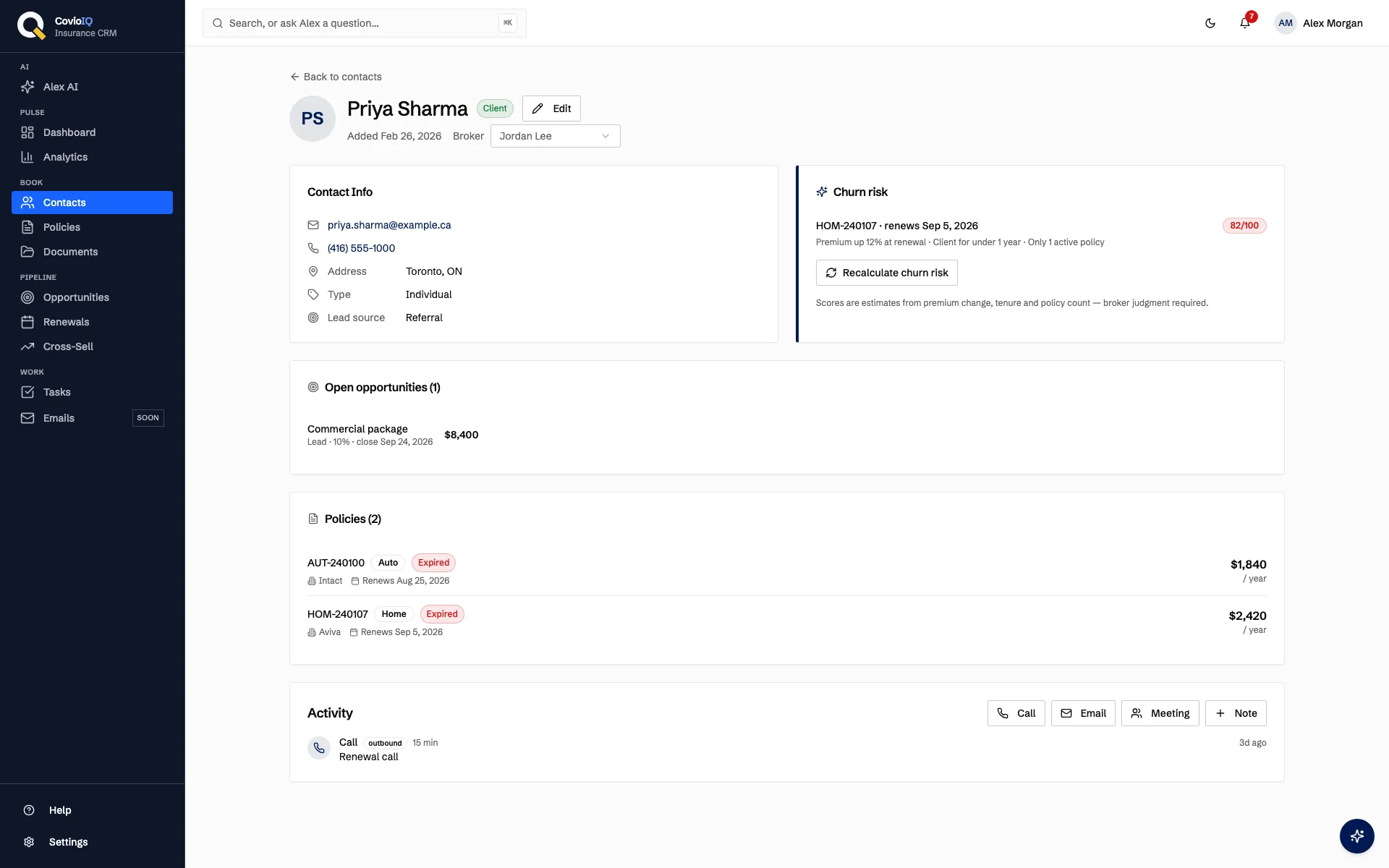
Renewals scoring 70 or higher are flagged high risk in the renewal table, on the client page and in the dashboard briefing, which totals the premium at stake on high-risk renewals. Because policies enter the pipeline 90 days before expiry, the flag appears while there is still time to act.
3. Decide What to Do
Suggested actions follow the factors behind the score: talk the client through the premium change, check in with a newer client, or review a single-policy relationship. CovioIQ does not contact clients for you; the next step stays your decision.
A Score You Can Read, Not a Black Box
Reasons shown beside every score
Each score lists the factors that produced it, for example: "Premium up 12% at renewal; Client for under 1 year; Only 1 active policy — lower switching cost". You can check the reasoning against what you know about the client.
A fixed rule set, with no outside AI model
Churn-risk scoring is a transparent rule set that runs in the database. It does not use machine learning or an AI provider, and no outside AI model sees your client data for scoring. Your data stays in Canada.
Updated nightly or on demand
Scores recompute every night. After you enter a renewal quote or update a client, click recalculate on the renewal or client to refresh the score straight away.
An estimate, not a verdict
The score only reflects premium change, tenure, policy count and how recently contact was logged. It does not know about claims or payment history, and it can only see conversations you actually logged in CovioIQ — a call you had but did not record looks to it like silence. So a high score is a prompt to look closer, not a certainty. It is not coverage advice, and broker judgment is required.
Churn Prediction FAQs
How does CovioIQ score churn risk?
CovioIQ uses a transparent rule set that runs in the database, not an AI or machine learning model. Every open renewal starts at 25 points. A premium increase at renewal adds 15, 25 or 35 points depending on its size, a client of under one year adds 20, and a client with exactly one active policy adds 20. A client with three or more active policies subtracts 15. The final score is kept between 5 and 98, and the reasons are shown beside it.
Which renewals get a churn-risk score?
Every open renewal in the renewal pipeline, meaning renewals in the upcoming, contacted or quoted stages. Policies enter the pipeline 90 days before expiry, so a score is available during that 90-day window.
What information does the score use?
Four factors from your own CovioIQ records: the quoted renewal premium compared with the current premium (when a quote has been entered), how long the client has been with you, how many active policies they hold, and how long it has been since a call, email, meeting or SMS was logged against them. It does not use claims history, payment behaviour, email open or click tracking, carrier data or market-rate comparisons.
How often are scores updated?
Scores recompute nightly. You can also click recalculate on a renewal or a client to refresh the score after you change the record, for example after entering a renewal quote.
Which plans include churn-risk scoring?
Churn-risk scoring is included on every plan, starting with Solo at $49/month CAD. You can try it with a 14-day free trial, no credit card required.
Does a high score mean a client will leave?
No. The score is an estimate that helps you decide which renewals to look at first. It is not a prediction of certainty and not coverage advice, and broker judgment is always required.
Included on Every Plan, Starting with Solo at $49/month
Churn-risk scoring is not an add-on. Every CovioIQ plan includes it, starting with Solo at $49/month CAD.
14-day free trial · No credit card required